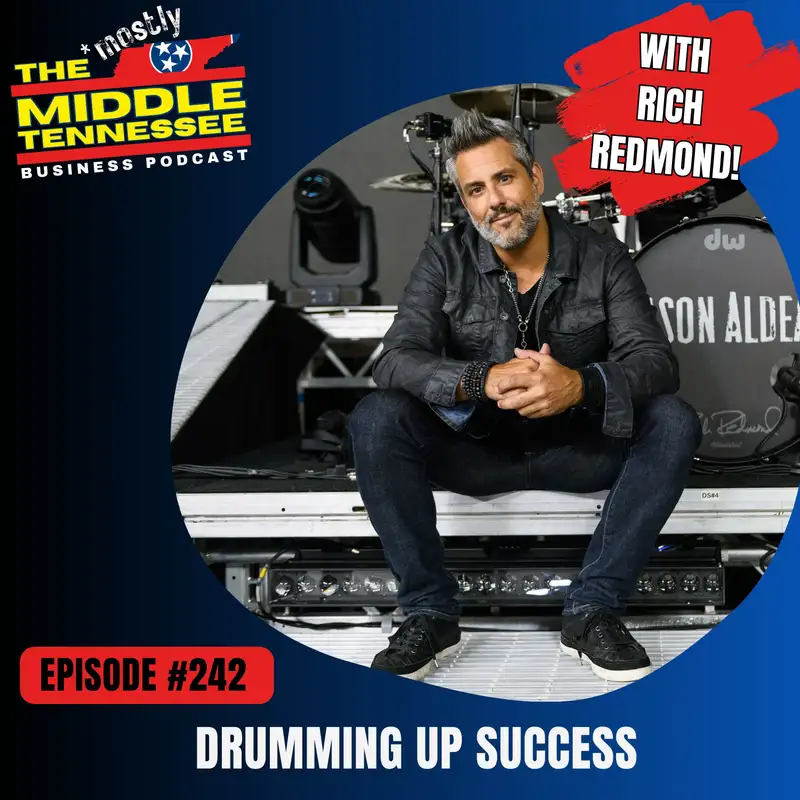
Drumming Up Success w/ Rich Redmond :: Ep 242 Mostly Middle Tennessee Business Podcast
Unknown: Like, hold on, hold on.
Let me do this. Would you let me
do this? Let me do this. Where
the hell is my freaking intro.
Here it
is. This is the mostly Middle
Tennessee business podcast.
Thank you. Podcast about Middle
Tennessee business owners and
professionals,
mostly. So you said you got a
new gig. Is that? Is that what
you're telling us,
oh, I've always wanted to do
Foley. Foley is a lot of fun.
It's very much like being a
percussionist, yeah. But it also
involves, you know, extreme
creativity and using sounds to
create things, which is like a
percussion instrument, and you
might do things like walk in
sand or run or break
watermelons. How
do you it's like, how do you get
all those fun sound effects?
That's exactly what I used to do
in radio, was creating different
sound effects from other sound
effects. So if I wanted the
sound effect of an arm breaking,
right? And that's typically
a tree branch breaking,
yeah? Remember the lasers and
Star Wars were hitting the sides
of those, the industrial wires,
the guy wires holding up
telephone poles. Yeah. So I've
got a friend in Hollywood,
George. He's a great drummer,
and he's been doing Foley for
2025, years, and
he gets paid to, you know, we
need you know, you watch like
the classic scene where Hugh
Jackman playing Wolverine, and
it's for the movie Logan, yeah,
and it's his last it's going up
leading up to the end of the
movie, and he's running through
the forest and everything they
had to overdub in a studio, his
reenactment of screaming and all
this other stuff. Yeah, not
crazy.
Gotta be perfectly in time. You
have to have great timing, like
a comedian or a drummer. And so,
you know, George is a drummer,
so she makes him I mean,
obviously, the funny thing is,
is that I'd like to do some
Foley, and he wants to jump on a
bus and take the music to the
people. The grass is always
greener, isn't it? Isn't it
interesting human nature,
dude, when I first met you, and
way back when Johnny Rabb was
also a part of the that, like
the grouping, I met a lot of
drummers around that time, and
it was kind of really cool,
because you let it off when we
met in 22,008 2008 and then I
reached, I don't know, I think I
we did your vid SIG, and that
led to the front men doing
theirs, because I saw what I did
with you, and Reggie did his. So
I think Johnny Rabb saw it. And
those, for those of you are
listening, you are listening to
the mostly Middle Tennessee
business podcast where we talk
to middle tennis Tennessee
business owners, entrepreneurs
and people who can't get a word
out of their mouth regularly,
regularly, and Rich and I have
been friends going on 18 years,
I would say at this point, yeah,
cuz we were basing it on your
son having his 17th birthday.
Yeah, yeah, correct. He doesn't
do anything fun, like a pin the
tail on the donkey
kind of a thing. No, you 17, you
know typically don't do those
things anymore. At 17,
you are typically not wanting to
hang out with adults.
He's, he's good, he's, he's
coming around. He's still kind
of like he's 17. You know how it
goes. He's, we're going to do
something fun with him. I think
tomorrow night, nice, yeah,
because he wants to, you know,
have no obligation of school the
next day. Don Arturo's, I don't
know, whatever he wants to do.
We kind of had dinner. He, you
know, he wanted Cracker Barrel,
because that's
where he works. Here in spring,
Hill in, yeah, yep, the
crossings, wow. Okay, so we are
doing a podcast tomorrow from
like, probably, like five to 615
or so, yeah, so I'll come crash
it. Come say hi to the birthday
boy. Let me know where you guys
end up. I'll let you, especially
if you end up at like,
Frankie's, or
if we even go out, yeah, we
don't like really, mean, we've
gone out this past weekend with
the most we've ever gone out in
a long time.
You guys beefed up your
backyard. You You know,
you got the pergola. It's nice.
Fire Pit, the grill, the fire
pits, major selling point.
But getting back to, you know,
back when I met you, you kind of
led that effort into me getting
to know like drum heroes, right?
Yeah, not that you know, Johnny
Rabb wasn't exactly a huge
influential drum hero to me, but
an amazing drummer, nonetheless,
fantastic any innovator,
inventor, entrepreneur, author,
author, he Geez, you know,
amazing teacher. And for those,
again, those of you listening,
look up Johnny Rabb. Look him up
on YouTube. You'll be blown away
with his technique and just the
stuff he can do on a drum. But
he, he said the same thing. He
wanted to do more of what you
were doing, and you wanted to do
more what he was doing in terms
of
clinics. And we ended up doing
that because then following his
lead, I was like, Wow, this
guy's writing books, and he's a
major clinician, doing that all
the time. So I leaned into that
and built that, and then he
ended up doing less of that, and
then getting an awesome gig for,
I think, maybe a decade now,
with collective soul, which I
cannot even believe, because
that's an amazing song book,
that's an amazing body. Work,
and you know, they're playing
mostly, yeah, that's right,
great. Which is the business of
musicianship, and specifically
drummers these days, you gotta,
you gotta be kind of an octopus.
You got to think outside the
box. Because it's funny, since
you've come to Nashville in 1997
you're good, Jim, you
did all things you you knew how
you didn't really have we
didn't. The Internet wasn't as
pervasive back then, certainly
not social media. Look at him.
He's doing Foley again. What
sound is that
could be a shaker and, like, a
nine inch nail song, if you
like, like, Lo Fi it,
you're kind of doing the, yeah,
if you take it out, that's,
that's a a filter of sorts,
yeah, dropping out the low end
and kicking up the high. You
know that you're basically
opening and closing a top
of a fun facing you, because on
my show, I'm usually in this
chair, yeah? And I got more of a
side angle. I
like to have you facing the
guest. Yeah, I know this is
great. I'm just the guy chiming
in from time to time. I'm the
idiot.
You're the robin Howard.
Yeah, that's what I am. You're
but back when you started in
1997 things were a lot, a lot
different. You know, you had to
actually have demos on CD. I'm
pretty sure, did you have
cassettes or CDs? Back then
I moved to town with 400
cassette demos, rich Redmond
drums and percussion,
and it's like, right there you
were, like, behind the
technological curve, my
goodness, because, I mean, were
there people like cassette
players are being phased out by,
well, quickly, I quickly, yeah,
got a bunch of CDs, CDs, and
then you
get a DVD reel happening, right?
And then before long, you and I
are on MySpace. We're meeting
via my space, and then Facebook
opened to the public in 2007 I
remember sitting in salmon zo's
The day it opened to the public,
and I said, I better get on this
thing. Somebody just told me,
get on this.
You get on MySpace. You're going
to meet Jim McCarthy. Your
life's going to change forever.
Well, you have been a great
maybe for the better, maybe for
the worst. That's yet to be
seen. I
probably no. I probably stole a
lot of either, you know, because
you have a, you know, you're a
voiceover artist, but you know,
you have guys like Mark Hamill
that have like 100 variations
on, like, some cartoon voices,
and that's his angle, and your
angle is more, you know, sound
and radio, softer, hard sales,
Monster Truck radio. So, you
know, I stole a lot of things
from you, like the, you
know.com, you know what I mean,
the.com Yeah, the fall offs and
the Gary love Vox. Yeah, we did
that back. That's right, we did
my last paid voiceover job was
doing a Live Nation tour
commercial for Gary levox.com
I don't know my last
one was, pull it
up. You have it on cassette? No,
I haven't.
It's it's really compelling,
great stuff. So much fun. And
you, can you believe? Thank you
for calling APCO. We are
currently closed. Please leave a
message.
Is that a hamburger gig, or a
steak gig? APCO, I believe is,
oh, it's certainly a hamburger,
yeah, but it's steady.
You know, it sounds good. Is
getting some nice grass fed
beef. And we
should probably reference what
that means. So grass fed is
hamburger versus steak.
Oh God, gotcha, yeah, gotcha in
this industry, is that because
you
actually you could, you could
probably talk about that,
because in the beginning,
getting to what you were you
wanted to do, and getting to
your current gig, yeah, you had
to take steak gigs, which were
nice when they came along, and
then the hamburger gigs were
would add up and pay the bills.
Yeah, right, yeah.
As creatives, you know, we
monetize our creativity. And you
know, sometimes you're playing
at, you know, Douglas corner
for, you know, $50 and then
sometimes you're on the tour bus
with a major label artist and
their first single is out, and
you're making $500 but you say,
we said yes to everything,
yeah, because you kind of had to
back then, because it was a lot
more a lot more difficult to get
your name out there and spread
your seed, a lot easier now,
with the advent of social media,
easier, dare I say you still
have to figure out what the
algorithm feels like doing at
that particular moment. What
hashtags are you using? Is it
being collaborated? Is you? Are
you getting people sharing it?
What's, you know, what's ticking
the box of the American culture
to help them get your stuff out?
You know, that seems to be the
biggest question these days,
back then, it was just all
about, get your name out there.
Yeah, you know, however you can
get it out there. So that meant
going down to Broadway. That
meant, you know, rubbing out,
rubbing elbows with everybody,
crashing parties, going to
drummer's hangs, going to
writers nights, telling writers
that you like their material,
giving them a card and saying,
Hey, next time you. Do this,
I'll bring my cajon or my jimbe,
and then, you know, this is
Nashville, songwriting capital
the world. Songwriters lead the
culture here, because without a
three chords in the truth and a
story being told, and then
there's no need for a drummer, a
producer, session musicians, a
live band, chefs, social media,
managers, day to day to day,
managers, labels, none of that
stuff. You gotta have a song
first. But no, you know, social
media you can use to open, to
crack a door, but then you gotta
walk through that door and try
to physically connect with those
people in real life. And that's
what I tried to make, make a
habit of, like, use social media
to create awareness. Yeah, and
then actually, in the real
world,
hit him up on the DMS, yeah,
which is a lot of what I do to
get to podcast guests of that
nature, starting that
relationship in a very authentic
way, very genuine approach. You
know, not like how we get hit up
on LinkedIn these days. What's
your LinkedIn game like when you
people are inboxing you? Well, I
wanted to ask you about LinkedIn
because I swear I have been on
LinkedIn for probably 15 or 16
years, and very, very, very
rarely. I actually don't even
know if I've ever gotten a job
from LinkedIn, but it just seems
like it creates awareness, and
then my the expectation is to
have one, especially since I'm a
speaker and an author on that
side of things, you're expected
to have a LinkedIn page, right?
I do better business on the
other social platforms,
but my inbox in LinkedIn
is, Hi, would you like to be in
the top 50 people under 60?
Yeah. Thanks for accepting my
request. Let me hit you with
three pages of my pitch that I'm
sure you're going to read, yeah,
because I'm so intriguing,
though.
And the fake profiles, you know,
from Malaysia, and you're like,
I don't know this
person, right? Broken English,
do you get the ones that like,
they'll, they'll send you a
message, and then a day or two
later, Hey, did you get my
message? Why aren't you
responding? You know that
they're like, that aggressive?
Well, you
know what's, what's really
interesting is like, you know,
whenever I am like, I use you as
a gage for authenticity, and
like to check, to check the gage
on potential projects. So I get
hit up all the time for these
interesting podcast shows, and
they're like, it's a, it's a
Facebook Live podcast that pays
$3,000 who's got a budget of
$3,000 to pay multiple guests?
Surely, they're trying to scam
you and get your bank
information right.
You know, that's good. That's
why I said, you know, my advice
was, well, if they have you on
and you have to give any sort of
credit card or anything, or hey,
you know, we're going to overpay
you and then refund the money.
What you know, you just refund
it to us. Yeah, that's
giving you. My thing is, I'm
just not going to respond,
because it just doesn't seem
legit. And if I don't know the
guest, and I don't know the
host, and they don't have much
of a following, I can't find
much information on them,
they're just going to ask me
whatever they want to ask me.
And I want to have a better read
on who's asking me questions,
because in my line of work, I
could be expected to answer on
behalf of a whole host of people
that I would not be comfortable
ever talking about, right? You
know,
right? It makes sense, yeah. But
I mean getting going back to our
original conversation, getting
here, 9798 99 oh, yeah, to now.
You know, with somebody new
coming to town, Broadway has
become a highly coveted gig.
Yeah, so here in Nashville, for
those of you who are listening
outside the area, they call it
lower broad basically, it's
turned into a giant tourist
destination, bachelorettes on
pedal taverns. Why am I talking
like,
hey, China, China.
Other things, you know, hot tub,
busses, a bunch of women on
there, and wedding dresses and
stuff, wooing away a lot of
people. I think that Friday and
Saturday nights they shut down
lower, broad, so it's pedestrian
only, kind of like Sixth Street
in Austin did that for years and
years and years.
Yeah, it's a good idea because,
I mean, it's attracting more
tourists, and it's better for
the city Beale Street, but, I
mean, those guys, when you came
here, Broadway was like stone,
but you had to cut your teeth at
least be abandoned the window
places to go play. You know how
much for the drummer in the
window? You know, I played in
Legends with this girl named
Christy cook. And she, of
course, wore the super, super,
super, super short Daisy Dukes
way up high. So, you know, her
cheeks were hanging out. And
everybody would pass by, and
they would like, they would come
in. It's like, what do you want
to hear? You're cheating heart.
Tammy Wynette, so it was good.
That was good training. And you
know, my buddy, Jim Riley, you
know, 20 years as the band
leader for the rascal flats. You
know, we went, we kind of went
to college, into the same
college, and kind of kicked
around Dallas together, ended up
in Nashville, and that was just
the thing to do. You went you
went down there, you played the
song book, you advertised your
wares, which was, you know,
trying to play nice musical
drums, and hopefully you had a
firm handshake, just trying to
shake trees and see what
happened.
But prior to this, you were in
Texas. Dallas in Dallas, right?
Amazing music scene. To this
day, some of the best cover
bands in the world are in
Dallas, Texas, because there's
just this incredible host of
musicians that go to, you know,
the University of North Texas,
this small, little sleepy town
Denton, Texas that just cranks
out world class musicians, you
know, and those musicians to
earn extra money will go work in
the Dallas clubs in the
evenings, or after graduating,
they'll kick around Dallas for a
year or two, save some money
before they move to New York, LA
or Nashville. And that's kind of
what I did, and and I knew that
I had to get out of town because
I got wind that my professor, Ed
Soph was like Redmond's still in
town, because I was down in
Dallas playing in the club's
killer top 40 band called random
access. He's like, Redmond,
still, he's got to get out of
here. He's not getting any
younger, you know,
like 23 at the time, 26 yeah,
getting any younger for
Coronavirus, yeah. But 26
becomes 30, really fast. Oh,
yeah, as we all know. But you
know, you you come to town from
that situation, because I played
in cover bands in Connecticut,
yeah, and I think we talked
about, I mean, what did you get
for a gig in Dallas, on average?
Back then, in 1995
the nightclubs paid 75 or 80
bucks, a man, a man. And then
that's for how long, for
corporate parties would pay
about 150 $175 and you have a
chance at, you know, getting a
slice of, you know, the bachelor
cake, the Groom's Cake, right?
And then some shrimp, maybe some
greasy tortellini. But you're
talking about five, six hours of
working, oh, yeah, because the
nightclubs, you'd have to load
in in the afternoon, so that
kind of ate up your whole day.
You'd have to go before the
dinner crowd, set up your kit,
and then the then the Nike. The
gig would be from like, 10 to
two. Oh, wow, late night. And
then after, after you break down
your drums and kibbutz and high
five and make your money, and
then drive home, you know, it
took everything in your power
not to stop at the Whataburger,
yeah, you know. And then you're
in bed by four in the morning.
And then I might have a music
theory class at eight in the
morning. That's a 12 hour day.
It's a long day to make, so if
you start crunching 80 bucks. So
what was I making? $8 an hour,
$7 an hour, yeah, but it wasn't
about the money. It was about
the 1000s. It was about the
experience that was leading to
the 10s of 1000s of hours of
experience. Connecticut.
Dude, we got paid. I think I
think I made 175
to 225 on average in a cover
band. Yeah, just outside of New
York.
Maybe it was saturated in
Dallas. So the musicians were
plus, I will say that that's
true. A lot of the nightclubs
there had live music seven
nights a week, yeah, from 10 to
two, right? You know. So you
bait a lot of competition, and
then big, you know, charismatic
churches, you know, I played in
Robert tilton's House bands. You
know, the guy that spoke in
tongues on TV. I was in his
band. There was jazz brunches,
there'd be Wednesday night
church services. There'd be some
killer big bands in Dallas, the
Dallas jazz orchestra, the
collection Jazz Orchestra, cool
rooms like strictly taboo, where
you would play cool smooth jazz,
you know, like Kenny G and Jeff
Lorber fusion. And it was a
really cool scene. There was,
like a soul funk scene. There
was this original music thing
happening down in Deep Ellum.
There's a section of town called
Deep Ellum where, like Edie
Bucha and the new Bohemians were
kind of formed. So Dallas is
always going to have a great
music scene because of the the
the schools that are in the
area, just like Nashville.
Nashville, we got TCU, we got
MTSU, we got Vandy, we got
Belmont. We got, it's a whole
three school of rocks. We got
two Bucha rocks. We got, it's
just a music
intensive city, yeah. So you got
a lot of competition here,
totally. But the funny thing is,
you know, you met my brother
this past weekend. We hung out
for a bit. He's like, I just
don't like the whole notion of,
you know, if I were to move
here, and he's an experienced,
seasoned musician, piano player,
getting on Broadway and begging
for money. And I'm like, But
dude, you know, you're in a
different a lot of these are
people trying to get broken into
the business and find a cool day
job. He's a lawyer. He's a
lawyer, and he can, he could pay
his bills. And I'm like, you
could do this, like, literally,
as a leisurely hobby. He's like,
TMZ Harvey, right? I'm a lawyer,
right? Yeah. And maybe I should,
even, you know, be a lawyer for
the industry itself. Yeah, give
him a fresh pair of eyes. But
it sounds like he's got another
chapter and city planned.
Yeah, he's kind of looking
towards different, you know,
Southern cities. I told him that
he's going to be a halfback. He
goes, What's a half pack? I
said, all the people from, like,
northern states, I think Florida
is great. And then they realize
they get down there, they're
there for six months, and this
is a place better visited than
lived. And then they make their
way halfway back to North
Carolina. Or interesting,
yeah, because my parents have
been in Florida for a very long
time. They went down there to
take care of my aging
grandparents and but that makes
sense for them. Just stayed,
yeah. I mean, you get the
vitamin D. It's wonderful. You
can't go outside in the month of
July. Lie in Florida, and, you
know, you've got mosquitoes and
gators. You know, gators is kind
of fun, you know, because it's
like, wow, it's just like,
dinosaurs are still roaming
among us. But they also have
these things called the no see
UMS. There's these little
annoying bugs that make sitting
outside and enjoying the
outdoors, like, nearly
impossible. Really, you got to,
just, like, cover yourself with,
you know, off, to just exist in
Florida.
So, yeah, he's looking towards
Florida, which I told him, I
said, you're going to be a half
back. Yeah, you're gonna, you're
gonna be over it in three to six
months. Or you could just bypass
all that and move here with your
little brother and, you know,
we're the only family we have
left of each other. Let's, let's
hang out, man, let's make it.
Let's work together and buy a
place in Florida that we can go
to and share. We could visit on
a regular
Well, Jim, you're very
persuasive. And maybe he'll,
hopefully he'd the call, but he
was all,
he was kind of like, up, and
he's like, I just don't want to
pass a bucket around on
Broadway.
And he doesn't have to do that.
Hey, believe me, if I ever
played blower Broadway again, I
would hopefully curate the
playlist, curate the musicians,
and we would get an attractive
woman to go, like, with the
bucket, right? I would never do
that. It's almost, it's almost
like patreon.com you and I can
have patreon.com on our podcast,
but it seems like we're just
patronizing. We're just why they
call it
Patreon, yes, but you know,
it's, in a way, it's not really
patronizing. You're saying, Hey,
we're not funding anything.
We're not being funded by
anybody. We're not you don't
hear any commercials on this
thing? Yeah? Help us support
it. Well, the most common pitch
on that angle is a this thing
requires massive amounts of work
and our time, so please help us
out. Right? Yeah, that's a
good pitch. Yeah, getting back
the whole Broadway thing, yeah,
when you came here, it was a
ghost town, kind of like a pain
in the butt, I guess to, you
know, well, I guess I'll do it.
You know, it sounds really, you
had to really. You were working
for peanuts at that point,
but no how we were excited to do
it. Jim and the parking was
free. I would park way up at the
church on the top of Broadway,
right, right, right by the
Bridgestone. And I had a little
rock and roller cart with my
cymbals and my pedal and my
snare drum and my sticks and
then my tools and parts, just
because, you know, the wing nuts
and everything would be walking
away all the time. You go on, go
down there. You get down there
early, you set up. You just
ready for anything. You're just
in your I mean, what? This was
an amazing time.
Do you remember like really
being in the moment then and
saying, I need to enjoy this?
Were you cognizant of that?
Absolutely not really, because
you were always looking forward
to the next thing, and
that's, that's our that's our
disease. In the human condition,
you have to really be self aware
and have just some, just some
spiritual training to like, you
know, know that, hey, life goes
by fast, and there's only one
now. So I should just enjoy
this. No matter what is
happening. I'm enjoying the heck
out of this sparkling ice. I'm
sure it's filled with aspartame,
but like, I'm just enjoying
this. I'm enjoying this time
together. And, you know, we're,
we're here now, now we look at
it that way, but back then, no,
you're like, Dude, I gotta make
something myself. Oh my god, I'm
out the
rush. It's like, oh my god, I
gotta get it done. I gotta get
done. I remember that being like
that in radio. Yeah, I spent
three years at i 95 I need, I
gotta find, I gotta move on.
It's time. I gotta move. I gotta
show that I'm, you know, making
moves and moving up the ladder
and get a gig, and
then you want a better gig, and
you want to gig that has more
dates, and gig has more
visibility, and then a gig that
pays better, and go, my God, I
need a gig where they have w2 so
I can buy a house. And then, you
know, and
then you all of a sudden, you,
you've had a couple of different
you were, you backed some pretty
big artists. Yeah, the biggest
one to date had was a seven year
play, which I find out, like we
just, you know, we've had on the
other podcast I produced. We had
Michael Knox, the producer for
Mr. Aldean. That was a great
episode. Did you listen to that
one? Yeah. And I texted Michael
afterwards, and I said, I just
wanted to thank you again. And
then a couple of days later, I
saw him because he had basically
hired al Dean's band to come and
play on this new kids record.
Tim Dunc, Tim Duggar on curb
records, yeah, it's always great
to have that team together, but
that team wouldn't be together
unless, you know, there wasn't a
Michael Knox to, you know,
believe in everybody. The
vision that guy must have had,
and the tenacity, that's what
I'd love to have and talk to him
about on this podcast, if he's
listening, is that, look, I want
to know about the days you woke
up and you wanted to quit. I'm
supposed to connect you guys.
So, yeah, good. I forgot it's on
my to do list. I
mean that that that is
interesting to me, but I keep on
like, tangent city right now.
It's funny because Broadway,
getting back to Broadway in the
beginning, you were excited to
do it, and the excitement kind
of compensated for the lack of
compensation. Because I remember
what that felt like in radio. It
was like Courtney and I were
talking about it the other
night. I said it wasn't a great
paying gig, but man, the
experiences we had, you know,
the people we met and all the
fun things we were able to do
were great for that time in our
life, until we finally had to
get serious and make some real
money. But for you, I guess it
was kind of similar, because now
you. Broadway is extremely like,
you really, you're gonna be
excited if you got a gig on
Broadway. Now, I think, because
it pays so much better, there's
so many more people down
there, it's just exciting down
there, you know, like, I don't
make a habit of going down
there, and usually, unless I
have out of towners, and we'll
go honky Tonkin, and we'll make
a day of it. And I'm definitely
going to go to laylas. I'm
definitely going to go to
Roberts. There's, like, certain,
certain spots where I just like,
wow, this is just, I mean,
Robert's western world is the
greatest Honky Tonk on the
planet.
20 years in this town, I've
never stepped foot in that.
We're going to go, we should go.
We'll get, we'll get our fried
bologna sandwich with the, you
know, the crinkle fries and a
Coors originally serve food
there, I guess they do. Yeah,
really good food. There's like,
a short order guy, really, yeah,
it's like a greasy burger. We'll
have to go. It's dirt cheap,
you know. Yeah, that sounds
appealing. Now, we probably
should have done that this past
Sunday with my brother. Oh,
they would have, because it's
literally, like walking back
into 1955 Yeah, a
lot of the old school country
you're going to hear is
in that tootsies, tootsies,
tootsies is the only room I have
an old school room. I've never
played in Nashville, in the
front room. I've played in the
back room or from the front
room, where you're like, right
in that little, tiny, little
window. Haven't, haven't done
that, really, haven't
even sat in there ever. You've
never played toads place either.
And
I have, I know, buddy, it's
amazing,
right by Yale University. Who
knows Yale's got a school of
music. Maybe I'll do a clinic
there. I think it's very
classical, you know, right? I
don't know if they have a jazz
program,
but you always had a bucket
list. You knew exactly what you
wanted to do, you know, again,
Broadway is a different beast.
Now for those people coming in,
still a good place to kind of
shake hands and kiss babies, rub
elbows with other music industry
types, I would think, but
probably a lot more tourists,
yeah, but don't, also, don't
make a career out of it, yeah,
you know, I mean, don't, don't,
don't,
you know, I'd be fine. You know,
if we did a, if I did a gig at,
you know, I kind of whatever I
felt like doing it, maybe a
Sunday afternoon, and I knew the
songs I would do it. It's like,
it's not important for me as a
drummer right now to be doing
what you do, you know, yeah,
it's just, I tell people, I
said, I'm glad I met you,
because it's not really, I'm not
sure if it was a life I would, I
would be matched for. Oh,
yeah, you were telling me you
didn't necessarily want to wake
up in a different city every
day. And there's something to me
is like, I love there's like a
troubadour in me, you know, I
don't necessarily have a guitar
strapped to my back and I'm
walking down the railroad tracks
to the next gig, you know, but
the idea of, you know, getting
on a bus with my friends and we
play some great music, and then
wake up in another city The next
morning, and, you know, there's
a chef inside. He and I said,
Can I get, you know, three over
medium eggs? And he makes them
for me. I mean, I kind of like
it. What's an over medium egg?
Over medium is where the whites
are done completely, but you can
still crack the
yellow. Oh, okay, yeah, isn't
that kind of like over easy? No,
over easy. There might be some
white slime. That's
not okay. And it's the same guy
every day, and he knows
exactly now it's different. We
have carried caterers with us,
but we have realized that for
some reason, sometimes the
quality control is better having
a different chef in every city,
because they're just trying to
impress you for that one.
Oh, wow. Good strategy.
Interesting. Yeah. So they show
up. Tell me about, like, a day
you're out on you're going to be
on tour in a couple of weeks.
Can wait for the big summer
tour. Yep. What's you get out
there? You know, you get, you
have bus call at night. What's
your what do you do? You get on
there. You just kind of hang
out.
And so we meet at the Walmart
Supercenter, yeah. And then, you
know, you get out of your bus,
you load your luggage into the
car. You hang your, you know,
your your your show shirts in
the back curtain. You set up
your little bunk, plug in your
plug in your iPhone. You set up
your little world. You take your
shoes off. You know your space,
yeah, it's our little on the
submarine. You know that your
coffin, your little coffin,
right? And it's, it's a very I
love it. Some guys don't like
it.
What if you have a CPAP? Anybody
have a CPAP on the bus? Not yet?
No. Where do you put the CPAP if
you have that would be so bad.
Seriously, I'd be hanging out in
the hallway, or it'd be pushed
up against the wall of the bus.
It'd be very uncommon. There's
no nightstands next to your bed?
No, yeah. It's as you it's body
size.
Yeah. So, you know, you kibbutz
with everybody, catch up with
everybody. You know, the you
know, and you know, we're My
guys are older now, and they got
kids, and they're used to
getting up at six in the
morning, so they might be right
in the bunk immediately, right?
You know, sleeping. But I might
have to wind down a little bit.
I might have to watch a scary
movie on the satellite. And
hopefully, you know, the the
buffering and everything is
good, because it is a satellite,
and sometimes you'll, like, get
a glitch. And it's the most
incredible part, all right? This
is where the chest bursters
coming out, and then it just
just pixelates, and then it
freezes there, and then five
miles down the road, it comes on
again. Oh,
good, yeah, it's rough. So
you're out in the general area
watching TV on the sofa,
whatever, and just rolling down,
or am I going to my bunk and
getting my iPad, and then I. Of
course, you can download things
from Netflix and, yeah, all
that. So I might do the thing
with the ears and the iPad. I
mean, it's, it's, it's easy
living man, you know. And then,
you know, set my alarm for the
next day. All right, typically,
is what we're gonna wake up and
say, We're gonna wake up in
North Carolina, the bus is
gonna, you look at your mileage,
oh, the bus is gonna pull in
around 730 in the morning. I'm
gonna, let's see, it's one
o'clock now. I'm gonna get up at
9am right? Because, really, I
don't have to do anything until
sound check at three in the
afternoon, right? Johnny's got
my back, setting up the drums
and all that kind of stuff. So
the first thing I'll do as I get
up, I probably go and get some
get some eggs to order, and then
I'm off to the gym somewhere.
But if we're in the middle of
nowhere festival, I carry in the
bay of the bus, a weight bench,
weights, a Bosu bands, jump
ropes, all the stuff to make a
little mobile gym. And I got a
little Bluetooth player, and I
get my Gatorade zero and a bunch
of cold waters, and kind of give
it hell. Get that out of the
way. Shower up, maybe go break
bread, lunch with somebody. Of
course, I've got this wonderful
street team of people around the
nation who I've met for all
these 20 plus years of touring.
So they remember, like, hey,
Redmond, I see you're gonna be
in town tomorrow. I'm gonna All
right, so I'll pull on at 730
come pick me up at, you know,
10am they pick me up and they
take me to the nice coffee shop.
We go get some coffee shop food.
A big fan of coffee shop food,
and catch up with that person.
They drop me off at the venue,
we do the sound check. Then, you
know, break bread with the band.
We have the thing called the 501
club. So at 501 we all go in, we
try to break bread together as
our little road family, and it's
just time together. And then
it's time to shower and such.
And then we have an acoustic
show. You're showering twice a
day, sometimes three times a
day, really, yeah. And then we
go ask that question. We do an
acoustic show, yeah, for these,
for the VIP high rollers, they
pay a little extra money, and
they'll get to see Jason answer
four or five questions, and us
play three songs, and I have
this little cajon rig that I can
play with my hands and a pedal
and sticks and brushes and
stuff. And it's kind of really
fun. And then that brings us to
about 7:45pm I get the sticks in
my hands, and it's more
kibitzing, and potentially walk
watching the opening acts at the
beginning of the tour. I always
like to take pictures and video
of the opening act. Drummers.
Just let them know. Hey, man, we
got solidarity. I got your back.
I'll get some videos of you that
you can use on the socials.
Maybe you'll do the same for me.
Yeah, go out there, do our show.
After the show, you get off
stage at 11pm you're drenched in
sweat. Definitely time for
another shower. It'd be cool
down with the guys a bit. You
know, we're cutting it's a lot
of very social life, yeah,
highly social, you know.
And do the same thing again in a
different city, they do the same
thing again. But
maybe I have a clinic. Maybe
it's a Saturday, right, and
they're picking me up at 9am and
then it's 45 minutes away the
drum shop or the high school or
wherever is 45 minutes away. And
then hopefully, you know, I send
them a nice little writer that
says, I like these drums. I let
them set set up this way. I like
them to sound this way. I just
want to pull in with my laptop
and my ears plug in, maybe tweak
the drums a little bit, and then
I could do and I could do some
teaching. I could do some
lessons, I could do a
masterclass. I could do a
clinic, and I might do a midday
corporate speech, you know, for
like, a chamber of commerce or
something like that. And then
they'll get me back, hopefully
in time for the sound check,
right? And I always try to be
there an hour before downbeat,
right? And then it's, you know,
more of the same. So it's all a
variation on what I'm eating,
who I'm visiting, am I teaching?
Let me get the workout in and
then execute that show. You
know, no matter what is going
on, you got to play those 24
shows, 24 songs, I guess, the
last time you're ever going to
play. Yeah, it might be. Here's
your life today. Yeah, this is a
highly coveted life that a lot
of musicians would love to have,
and probably kill to have. That
you're coming to Nashville. Are
they putting it? Putting
yourself it can be done.
Obviously, you getting back to,
you know, let's say 2000 2001
you're still here. You're
grinding it out, you're figuring
out the system and stuff like
that. You've already met Jason
99 I believe 99 Yeah, you know
all of you, he was probably just
like, I'm gonna dare say that a
lot of the artists, as a
musician, if you're an artist,
you got to look at it. My
lottery ticket is me, right, and
it's either going to win or it's
going to fail. And I could
probably get into other areas of
the music business, but I'm
going to try my shot. I'm taking
my shot at being a big artist.
I'm going to play the big
gamble. So to speak with a
musician, you get to play a
bunch of different lottery
tickets, you know, side person,
that kind of thing. Artists are
like, you know, we got it. You
got to spread your seed, get the
experience the time in the
trenches. And hey, one of them
might hit, you know, Oh, yeah.
That's kind of like the the
odds, in a way. But it's funny,
because going back to what we're
talking about with Mr. Michael
Knox and Jason, seven years i.
That's blows my mind, that they
stuck with it. That is a long
time, deep commitment. Would to
have a proof of proof of concept
in a business idea, and have the
faith to see it through amazing
it's, it's, thank God. It's mind
numbing to think about that, you
know, because you were a part of
that journey, but you were also
doing other things because
you had to pay the bills, right?
Yeah,
he was a part of your story, but
a minute part, you know, because
you had so many at one point you
were playing with, how many
bands
we had? 2029, bands in one year,
in one year without any zero
conflict, that's crazy. So
that's God saying. I want you to
get even more experience. I want
you to cut your teeth more.
Yeah, you're not. What was it
like, baby? Going to give you
the big prize yet,
right? Six years of doing that,
though, you had to be like when
you know I know something's
bound to happen. You just had to
know intrinsically in your gut
that I'm destined to be a big
name in this town, out of this
town, in this country, in the
drumming community, which you
have become. But what were the
days like, where you like, is
this really that had to cross
your mind? Is this really going
to happen? Did you have your
doubts? Did you have those days
where you're like, I just, I'm
freaking exhausted. You know,
it's just, it's a grind.
Even there were days that I
called Haagen Dazs, days where
you kind of range on a pie to
Haagen Dazs, because you're just
like, well, man. But luckily,
there was, you know, a bunch of
true believers, you know, the
Michael Knox's and, you know,
you know, I had Kurt and Tully
in my life to kind of lean on,
because we were kind of like a
unit, you know, we had a we, you
know, we were playing with
Jason, we were playing with Tim
rush low. We were highly
coveted, sought after showcase
band. We were started to do demo
sessions together for all sorts
of publishing companies. We had
a rock band called feeling
Fiona, and we played 12th and
Porter and third and Lindsley.
And so there's a strength in
numbers thing that's nice where
you can kind of lean on other
people, and that's right, yeah,
I tell people that could be a
model, that could be a business
model for you. Yes, it's kind of
the music businesses, like every
man for himself, you against the
world kind of thing. But it sure
is nice to find like minded
people that you know, and found
a tribe. Yeah, yeah. It's nice.
So it helps you weather that
storm, tons of storms. Yeah, it
sucks doing it by yourself, and
it's nice Michael. Michael Knox
would be like, Hey, here's a
gift card, or, Hey, I got lunch
covered for you guys today. And,
you know,
and is like, you know, he's a
rarity in the business too,
because he's waiting on his
return. Yeah, you know, he had
some pretty big jobs, and it
paid the bills, I'm sure, but
not to the point where he was
taking that money and
reinvesting it into a lottery
ticket, essentially, you know, I
mean, it's, he's continuously
pumping it into that. And I just
know something. I mean, I think
the number was 40 showcases you
guys did, yeah, so many. My
gosh, that
would never happen today. That
would never happen today, and it
would be really rare to find a
group of people that would stay
together for seven years. That's
what I'm saying. It would be,
when was the
last time? What was, if it
didn't happen in seven would you
was still stuck around for
eight, nine or 10? I'm sure.
I mean, look at the guys like,
you know, there's other stories,
like the ELI young band. Let's
just tell it. Say the ELI young
band, you know, they ended up
having a nice couple of kids and
hits, and they have a good
career, but they were kicking
around all over Texas for about
a decade trying to make it
happen. Gosh, you got to do it
for the joy at that point. Got
to love playing your instrument.
Yeah, you know what I mean. No
matter what happens, I love the
physical act of playing my
instrument, and then how it
makes me feel, and then how it
makes others feel and impacts
their life. I mean, it's just
playing the drums. It's just a
win, win. I mean, my whole goal
in life is to just, you know,
keep taking care of myself,
because it's such a physical
instrument, so I could keep
doing that thing. And I think of
the people that are continue to
doing it at the highest levels.
I mean, Louis Belson played to
the practically the day he died,
you know, Roy Haynes was in his
80s, an amazing jazz drummer.
They just, guys are just, I'm a
lifer. I'm gonna play my
instrument till I drop. I have,
you know, during my speech, I
have a, I have a, you know, a
moment where I go, I'm probably
going to go out like this, whoa,
you know, counting off a song.
And that'll be a glorious
moment, because I will be in my
purpose, sitting behind this
thing that is a physical
manifestation of my purpose in
life. You know, that's nuts,
man, because it's
you really have to enjoy the
journey. I love it. You have to
love my craft, man, yeah, I'm
like, when you start thinking of
like painters, you know these
guys that you know, they have to
rent some place that's big
enough for their, their the
materials that they need. They
can throw paint at a wall and
they just, they're just in. I
didn't, I don't know how they're
paying their bills, and that at
some point, some taste maker
comes along and says, I approve
of this, and I will bring this
to all of my rich friends. And
the next thing you know,
someone's paying $2 million for
this piece. And is that artist
going to probably upgrade his
art studio and his quality of
life, probably, but really it's
the focus his reason is, or
their Why is, its purpose is the
painting? Yeah, you know,
I actually typically try to look
up questions.
Oh, I was going to tell my while
I got you here. This was kind of
an interesting moment. I keep
telling people that I'm having a
midlife crisis. I think I've
been having it for 15 years. But
anyways, I've been going around
Nashville and going to old
houses and condos that I have
owned or I lived in. So today, I
was out in Donaldson, Tennessee
by the airport, and I have a
good friend of mine, George
Bruner. And George Bruner, he's
a craftsman. He's a leather
worker, and he combines leather
and metal, and he makes these
really nice handmade jewelry.
And you know, a bunch of rock
and rollers wear them. You know,
Kenny are enough. Where's his
stuff? And so anyways, I was, he
was making a new belt for me
that I'm wearing right now, and
I was looking through this tub
of cuffs. And I go, I put this
one on, and it fits, and he
goes, he goes, Oh, man, do you
realize that I made this for
you, but it's for some reason.
Last time you saw me, you passed
on it. But he goes, that metal
on there is actually a piece of
John Wysocki symbol from the
band stain. So John Wysocki was
a member of our community and
was a good friend of all of
ours, and he died about a year
ago, and this was a part of his
symbol. And so for some one
reason today, I tried this thing
on. He goes, he goes, take it,
man, I made it for you. You
didn't take it last time. Let's
hold it up for the camera. Yeah.
So, so this is a piece of John
Wysocki, God rest his soul,
drummers symbol. And so I'm
wearing this today. Now I can
look down and think about our
friend John. That's great. It's
a really interesting so, I
mean, really like, you know, all
the instruments us being
drummers, we are imprinting our
personality on those
instruments. Yeah, you know,
Bruner model works. So I went to
go see George today. I'll go see
him, you know, once you're once
a year before tour, and to say,
Hey, you got any new leather?
Yeah, you know, you know. I
mean, I'm a fan of of a dead cow
all the guy, you know, they say
that nice guys finish last, you
know, I think about a Michael
Knox, and he just had the faith
and the long obedience in the
same direction when it came to
just believing in his artist,
you know, and he believed in you
guys. I, despite all the biggies
telling me that, Nah, I just
don't see anything. I believe
in. This thing's gonna pay off
someday, absolutely, and I'm
willing to put the time in.
Yeah, you on the other hand, you
know you being, you know, you're
a great guy, a nice guy.
Everybody loves you, who comes
across, even everybody that
we've had recently on your your
podcast. It's amazing to me,
unprompted, we're not prompting
them at all. Guys, you go and
listen to the rich Redmond show.
Go check it out. Rich
redmond.com forward slash
podcast. It probably in the last
I want to say 567, episodes,
we've had some of the newer
people to town that have made a
name for themselves, who have
literally listened to you and
absorbed your wisdom and the
things that you've had to say
over the last 20 years, and now
they're, they're, you're like,
they're you're not pro you,
they're doing it and that you
were no These. Nobody's being
prompted. Everybody feels
compelled to like Thank you.
We're doing what you did and
showing us how to do it, and
that's starting to come around.
Now, crazy. It is crazy. It's
not, though, because that's what
you set out to do. You. What was
your your card? What did this
say? What was your mantra when
you got here? Remember when we
talked about
the first card I ever had when I
came to town was
Vistaprint. You know? Because,
if so, not a business card, but
your yourself, your mantra, oh,
my mantra is, my purpose in life
is to affect people in a
positive way and change lives.
And my
was it kind of, did you know you
were going to do that? Or was it
kind of like, this is, yeah,
this is a lofty goal. If I do
great. If not, who knows if I'll
ever know? Well, you can that
that validation is happening
now. Yeah, it's cool, man.
That is cool because it is cool
to see. You know, like I said,
you know, I've never had
children. I'm always uncle
Richie. You know, Uncle Richie
is the cool uncle, and that's
great. But I start looking
online, and I thinking, Oh, my
God, oh, I taught that person. I
taught that person. I taught
that person. They took my class.
They came to drummers weekend.
Oh my god. Hundreds of people
they have read has really added
up. And I could look at their
careers and go, Wow, they just
signed with a major rock band.
That person just finished
Berkeley College of Music. That
person got accepted to the
University of North Texas. That
person's writing. A Buster
playing with a hit. Wow, did
that person bought a house?
Yeah, hold for with their drums.
And so if I can have any, you
know, like I said, I'm not a
genius, I'm just in my purpose.
And if there's a ripple effect
of a person being in their
purpose and enjoying what they
do and it helps others,
fantastic, you know, because I
am a teacher, I've always been a
teacher. You know, I have a
teacher's heart. I was trained
to be a teacher. I have my
masters in music education. So
along the lines, you have to
write a lot of papers, you have
to study a lot of pedagogical
practices. You have to study
educational philosophies. And
you know, how you might, you
know, conduct a high school
choir or a high school symphonic
band or score for a marching
band, all sorts of things they
don't necessarily use all the
time, but I'm sure glad I did
it. You know that no one can
take that away from me. I mean,
I hated studying the clarinet. I
hated making shapes on a
football field with a with a
marching band, but it was a
means, it's just because I
wanted to be, I wanted to be in
a rock band. You know, I was 18
years old, and I really wanted
to be in a rock band. What was
all your that's like being a
comedian, that's about as safe
as being a comedian. So my
parents were like, look at we're
going to go to school for four
years. You're only going to be
2122 years old when you get out
and you'll have something that
no one can take away from you.
And then, while you're there,
jumping through these flaming
hoops of taking science of sound
and studying the bassoon for a
semester, I got to practice
hours and hours every single
day, and all summer, I'm in the
music building at Texas Tech
University, and I have my
professor, Alan Shin, gave me
one of the beautiful Wenger
lockout units that was like had
AC in it, and I had my set of
Remo drums in there, and like
stacks and stacks of method
books and a leases sr 16 going
through a bass amp, and I could
just practice and practice and
transcribe 12 hours a day and
sit in my room and work on my
cup, slap on the conga, and then
get in there, and, you know
what, I mean, listen to Fusion
records, and it was so it was a
great time in life, you know,
was
it great? Did you realize how
great it was at that time,
still wanted to be out there
doing it, you know? Because
every time a clinician would
come into town, or I played in
the big band at Texas Tech
University. And we'd have these
amazing guys that would come in,
like Steve Wiest, who was in,
you know, Maynard Ferguson's
band with Greg Bissonette. He
would come in, Dennis de Blasio,
the guys from the yellow jackets
would come in. There'd be all
these guest artists, and I would
just be so excited to meet them,
because they would always live
in New York or LA and I'd be
like, you know, and I haven't
really, I hadn't really gotten
out of Connecticut or Texas, and
I was like, What's it like in
sunny Los Angeles, and what's it
like to play on the mean streets
of Manhattan? Are you telling me
you got to move your drums
around in a taxi? Will they stop
for you? Like, what does it pay?
Where do you live? Like, it was
just,
oh, to me, it sounds like a
nightmare. Well,
you know, looking back on it,
it's a young man's game. Yeah,
you know, I mean, Sean Pelton,
you know, 25 years as the
drummer, was Saturday Night
Live. He's like, Man, I lived in
this, you know, rat infested
apartment on the fourth floor,
and he'd have to schlep his
drums. There's no elevator.
You'd have to, you know, dodge
homeless people and people
taking dumps in the street to
get his drums up to his fourth
floor, you know, studio
apartment. And you know, how
many higher drum sets, how many
years later? Yeah, he's the
contractor for the Saturday
Night Live Band. He's played on
some of the most iconic records
of all time, and and he owns, I
believe it's like an urban
legend, two sizable apartments
in Manhattan. He knocked the
wall down, and he got a nice pad
with a studio, recording studio
in his apartment. Good for him
in Manhattan. Yeah, that is not
easily done. Well, he put the
time in. He put the time in and
he got a television job. And
television jobs pay rate,
because there's a union and
there's residuals, right? So
every episode that reruns of
Saturday Night Live, he's seeing
a check
so, but does he? He's got to be
a part of the episode, though,
at some point, and typically he
is. He's on camera,
he's on camera, and he's on the
and he's backing up artists, and
then that's good. We need to get
hit by
Sean. Would be great. You know,
when we played SNL in 2017 you
know, it was nice. He took the
time to come backstage and give
me a hug and say, I like what
you're doing. I read your
articles in MD, and was he? Did
he know who you were? Yeah, did
you meet him before then
it's, I'm sure we we knew of
each other. Yeah, you know, we
never personally met. Yeah, we
met personally. Then he's like,
yeah, man, good job. Reach out
to him. Was great. He'd be a
good guy to get out. Yeah, zoom
it up. I'd love to talk we got a
zoom tomorrow with Stan Lynch,
the original drummer from Tom
Petty, 20 years with Tom Petty.
I mean, that's going to be and
I've known. And I've known Stan
since in the year 2000 that's
when I met him, 25 years ago.
Well, it's 20 longer than 20
years he's he's been Tom Petty's
drummer the
entire but I met him in the year
2000 when I was me, Kurt and
Tully were in the in the house
band for the Warner chapel
songwriting camp, and we
basically just sat in the studio
all day, and Stan would write
with Ital Sure, who was this guy
who wrote and digging for
Carlos? Never heard of it. He
wrote that jewel was there.
Robbie Neville was there. You
know the he had that song, c'est
la vie. Say La Vie and Neville
Brothers, no not rob this is
Robbie Neville. He was a pop
artist in the late 80s. I
thought that was,
say, loving
I thought Robbie Neville was
part of the Neville
you're thinking about Ian Ian
Neville. Ian Neville, and
there's a guy that had the mole
on his leg. They
were like they were big guys,
and they always looked like they
were squeezing the crap out of
the microphone. Yeah,
yeah. Well, shame on us for
shame on us for not remembering
the Neville Brothers. Aaron
Neville. Aaron Neville, there
you go. Yes, Robbie. I think
Robbie might have been his
brother. Oh,
yeah, I'm wrong. Different
ethnicity. Okay, I see.
So. Anyways, yeah, tell me what
was like to hear yourself. You
know, I know we've talked about
it before, especially in the
world, world class, award
winning documentary we both put
together, working the dream.
Working the dream on YouTube.
You can go check it out. It's
only about 45 minutes long, and
perfect for an hour long
documentary that needs
commercial breaks. Well,
actually 45 minutes, but
originally it was probably two
and a half hours, but I kept
telling you to take things out,
because I was so gun shy at that
point in my career. About
your so what you were only
people PR sensitive, you
know? And I still am, you know
what? I mean? Yeah, I know you
we're in a world where at any
moment, things could be taken as
sound bites, and they can be
taken out of context and used in
an inappropriate way, which is
very scary,
but I think ultimately, yes,
you're right, but we're also to
the point as a society where we
are our skepticism is at such a
level that we automatically
think it's fake. Okay, so it's
either AI, I know, the other day
I saw, you know, I watched these
boat videos, wavy boats,
especially where you'll see
these people in a in an inlet,
haul over inlet. And I think,
dude, at this point in my life,
if it gives me joy, I go for it.
You guys kind of gravitate
towards it. That's why I've got
all the Marvel stuff up to my
left. And, you know, I got back
in the drumming again, and I'm
enjoying it. With that. I just
enjoy watching boats like idiots
and pontoons going through this
tumultuous inlet, which is like
one of the most world's most
tumultuous inlets ever. You
know, high tide and low tide.
This thing just eats boats and,
oh, let's take it out in the
ocean, the rental pontoon from
the bay. And it's like, these
guys just get their stupid human
tricks. It's awesome. Yeah. So
I'm watching one the other day,
and it says, this wave comes up.
Watch the wave. You know, wait
for it. That's the big thing.
They put in the text, wait, wait
for it, because they want you to
watch the entire video. Helps
the algorithm. And, you know, in
the video, this seemingly like
you know what you'd see at a
beach. What do you gotta
do? Okay, I'm passing up on a
great opportunity for
everybody. We're gonna we're
gonna make sure it's on there,
but you got to put it in
prominence. Give me the book.
We're doing this live hand to
hand it to me. I'll put it in
back of me. Actually, I think
I'm gonna have potential.
See, guys, this is happen as
we're recording, made us leave
it in to the chopper. So in this
video, they got like what
seemingly is like a beach wave,
a very medium sized beach wave
that you'd go body surfing on
the beach. It comes over the
boat and, like, takes the entire
boat, like, oh my gosh, the
whole thing disappeared. It's
AI. It's fake. And I was like,
almost like, Oh, really. Come
on, that would have been a cool
video. Otherwise, you know,
you know, the AI generated
headshots and such. I'm
interested to see,
yeah, but you know, they did
that a couple of years ago. I
did that too, and you pay for
like, a pack of 10 pictures, or
whoever, however, $10 for a
bunch of like 100 pictures. But
they take about seven pictures
of you, and have different AI,
they take your, like, your
attitudes, your facial
structure, general, you know how
you smile if you don't smile.
And then they put personalities
to it. It's odd. I'll have to
show it to you. They like, they
made me look like Bruce Willis
from Armageddon. Remember that?
Yeah, there was like, one point
where I had my shirt off and I
was jacked, you know? And I'm
like, I wish I looked like that.
But it was also. When I was bald
and had the, you know, the
badass beard bald look, until
Courtney wanted my hair to grow
back. I love it. But, yeah,
those things got nice little
head of hair. You working on
there, buddy. Now they got aI
flying apps. You could actually
upload your photo and likeness,
and they'll make videos of you
flying.
I mean, where is it going? I
just don't know. Man, you know
it's,
you know, any we just heard
about an app that apparently
will strip instruments out of
songs. I
don't like it. I know you don't
like that. I know I don't like
it, buddy.
That brings me to the business
of music. I mean, ever since
Napster, your industry has just
been in flux. But you know,
maybe it's fair to say that even
in in while the formats of the
delivery of the music changed,
you had eight track, you had
vinyl, you had cassette, then it
went to CD, then it went to mp
three. But since Napster, the
industry has been shaken up,
right? Yeah,
it would be interesting to have
found I'm grateful for
everything that I have my life,
and work so hard for it, and
it's fantastic. But what if I
had hit with a rock band in the
My 20s, in the 90s, because,
because that was the velvet rope
era. I mean, that was limos and
velvet
ropes, but I think it was
trending down by that point. I
want to say the mid eight the
80s was more like
there was money in the music
business. Then water. Yeah, in
the 90s, the 90s, people battle
the boom and, you know, sound
garden and Pearl Jam and modern
rock radio. And
did singles ever take off like,
you know, remember the singles
when they had offered it was
like buying mp three. Now you
buy, you spend your buck on
iTunes. You just want the song.
Now it's just all streaming.
Were singles a big thing back in
the 90s? Or they still, they
still bought out albums, right?
People still bought albums,
yeah, but you had to have a
single for the radio. You know,
there's the new one from Stone
Temple Pilots, right? You know?
Oh, yeah, of course. Man, that
was a heyday of quality rock
bands.
90s music, to me, was such a
hodgepodge. It was such an
interesting time for new music
to come out, because I was
certainly, I was listening at
that time more to than modern
rock stations, because I was
getting in the radio. I wanted
to get in the radio. I wanted to
work for 92 3k rock in New York
City, and they were the premier
modern rock, active rock, well,
probably modern rocket.
But if you had gotten the lead
DJ job at that station in New
York City, that
would be impossible, because it
was Howard Stern at the time. He
was a morning guy,
okay, but what I'm saying is, if
you were a rock jock on one of
the other shifts, right, did
it pay a lot of money in that
city? Oh, yeah, you made,
probably I would have, if you're
an afternoon guy, 200 probably
250 quarter
of a million dollars in 1990s
money. Yep, and you were
actually had a say in what was
played? No,
I think you probably, you, yeah,
you probably had a say,
depending on their role. If they
were music director. Music
directors typically brought
late, they would be the first
ones to hear what the record
company representatives would be
like, Hey, could you, you know,
add this this week? How many
spins can we get they would have
those conversations. And then,
typically, the music director
would bring it to the program
director and say, Hey, what do
you think? Let's, you know,
let's put it in, you know,
rotation at night, in the
evening, see how it does, how
does the audience respond? So it
was very organic. I would say,
back then, to a certain point, I
think paid a Paola was still a
thing, you know, in terms of
wining and dining, but, you
know, not like it was in the 70s
and 80s with the boss jocks so
interesting.
And when you played that new
single from Stone Temple Pilots,
was it still the physical CD?
Blow on it, put it on Yeah,
because there was a risk of it
being scratched or having dust
on
it, you they would sit in their
own like, ready to go jewel
cases, and you'd put it into the
CD player, which is a
specialized industrial,
commercial CD player, and it
would queue up. You'd dial, you
had a little knob on it, you'd
dial with the track in, and it
would be ready to go. And
typically on the board, you'd
fire it right from the board,
you know? And that, that was in
the mid 90s, was the last
bastion of hardware based,
hardware based disc jockeys that
were one step beyond queuing up
vinyl, because that used to
happen, they would have to sit
there and hold the vinyl, and
the turntable underneath would
be spinning, and they just hold
on and be like until they're
ready. Okay, here's an and they
would back it up so they
wouldn't have really, you know?
Yeah, it was. It's an art form.
There's actually, you go to
California Air, check on
YouTube, and it's fascinating.
Like the guys from the 80s
pulling their music and their
writing game, and they're
hitting the post, those are
videos of it. Oh yeah, it's
amazing to watch. I mean, it was
a true.
Word for awesome skill set. And
then if those guys stayed in the
business, and they were trying
to stay relevant, to keep up
with the latest technology, they
had to totally change to a
software based system.
Well, that's when automation
came in, voice tracking. That's
about the time I got in the
radio. Was when all the things
started, you know, I got into
the at the point where
everything was on a computer. I
literally, in my live shift, I
would hit a button and it's got
to, you make an art out of it.
Oh, I totally, I did the the
thumb slap, or the, you know,
the, you know, my hurt my
finger. But yeah, that kind of a
thing. Nice. No, no. Homer, rock
and roll. I 95 bam,
bam. See percussion again,
right? Exactly. Percussion,
DJing percussion, working in
radio percussion,
exactly, but it was, it was a
kind of a cool experience. One
day I came in for my shift, and
the entire system shit the bed.
Everything was down. What
happened? The whole the hard
drives just crashed, and all the
stuff, all the commercials, all
the music, they had to go back,
to quote, the stone age. They
kept their wall of music readily
available in the studio for that
purpose, maybe, or maybe for
esthetics. But getting all the
commercials, all the spot sets,
literally, the production
director's job that day was to
put all the spot sets on reel to
reel, and they would carry in
the platters and say, Okay,
here's the next hour. Yeah,
here's the next hour, here's the
next hour, here's the next hour.
And because that was important,
they had to make sure that they
played the spots. That's how we
got paid. Interesting. And, you
know, he had to put them all
back to back. Not a fun job, but
getting a taste of running the
board manually was a lot of fun
pulling your music the next hour
of music. That was a lot looking
forward on the logs and seeing
where you are and stuff. I had a
blast, because you had to stay
there for six hours being on the
air,
I'm sure. And you had your P
songs, right? Like steroid of
heaven.
Yep, sorry to heaven. And white
satin. I
love it, yeah. But it just goes
to show, if you're an open
minded person, you notice that
every person that has any job on
this planet, there is an art
form to that job, whether it you
are a janitor or a host at brick
tops, or you are a garbage man,
or you are creating high Art, or
you, like every there is an art
to doing a job, a job, well
done. There's an art form to all
of it. Good point. I mean,
there's actually in the
electrical field, because trades
are starting to make a huge
comeback, dude, I found out
yesterday at ntsu, they have a
concrete program to pour
concrete, to learn about
concrete. Yeah, it's a whole
degreed program. And these guys
that are coming out of this
program, they could make 80 to
$150,000 a year within the first
year or two. It's awesome,
because there's no about the
chemistry of concrete and what
works and what it's I learned
about this yesterday. It's
crazy. As you know, concrete can
be an art form. Well, thank God
for the trades. You know, like
you look at electrical there are
guys on Instagram that are
getting tool deals and
representation and things of
that nature. There's a guy named
Tennessee electrician, and he'll
just put a camera behind him and
rework a panel, you know, pull
all the guts out, redo the wire,
make the wire like, have like,
you know, just they're all
parallel to each other. It's to
watch somebody put properly, put
a panel together and redress it
up. It's about an eight hour
job, yeah, but when you time
compress and you see the
artistry involved when it's done
properly, it's freaking
beautiful when it's done. You
ever go into Costco, like these
big warehouses, and look up,
look at the pipes that are
running, the big the silver
pipes, somebody has to bend
those and they got to be
perfect. They got to fall in
light. That's a freaking art
form. Yeah, bending pipe and
conduit in the electrical field
is truly an art
form. And if you have pride in
your job, there is even an art
form to be in. The guy that
works at the deli counter at
Publix, there was a young man. I
went in there and I said, Hey,
my parents are coming. First of
all, big smile on his face.
Young kid, kind of unexpected.
How you doing, sir? How can I
help you today? I mean, total
sincerity. Oh, parents are
coming in town. I was thinking
about getting maybe, like,
maybe, like, a full pound of
your boars head, black pepper.
Great choice. How, how many
sandwiches you think you're
gonna have to make? Like, he's
totally, he's got the sales
process down. And I was like,
Dude, I'm probably gonna, we're
probably gonna have about four
sandwiches, but we might do that
two times, all right, so eight
sandwiches and two slices of
turkey. You think per sandwich?
I'm like, Oh yeah, my dad
Dagwood. He wants to make some
dagwoods totally set me up
because let me know if you need
anything else. You know, I'm
here, Monday, Wednesday, Fridays
great. I mean, it's like, wow,
what a pleasurable experience.
Yeah, or when somebody's
checking you out at the counter
at Publix, and they're they are
efficient, they have a smile,
they're pleasant. They. Help you
bag everything. It's, you know,
because I've seen the opposite
ends of the spectrum. Oh,
totally. We have those. Sucks.
Yeah, because that's what you
expect, though. Because it's a
supermarket, they're taking your
money either way. So if you're
going to take my money, God, if
it's pleasurable,
yeah, the experience matters,
yeah. And when you got somebody
who is an entertaining aspect of
it. Look at the bartenders. You
ever see a flare tender? You had
to in your days on the road. If
I was a bartender, I would be a
flare tender. You know what a
flare tender is? Put some, you
know, some spins Tom, some Tom
Cruise stuff, Tom Cruise, like
cocktail, right? So we first saw
that when we moved to Vegas, and
that bartender made bank because
you're entertaining. Now,
even if you don't go that far
and you are just a great person
on it, you're on it. And if the
you have the art of like,
there's someone way down at the
bar, he's holding up $100 bill.
He's just trying to get your
attention. He's not, I've done
that. I'm not trying to be
douche. I'm just letting you
know, hey, I'm gonna hook you
up, bro, yeah, it just give me,
give me a nod and be like, one
second, or I'll be right with
you or something. It's the ones
that ignore you. And he's like,
is it my ever going to be
greeted? Here am I chopped
liver? It's acknowledgement.
Acknowledge. Huge, huge, big.
Yeah, you know, being a session
drummer. Well, that's the
thing that you talked about, um,
you know, in like, we kind of
did some driving scenes, and we
would ask questions, demand
element, which, back in the good
old days, it's the best car
ever. Know about you. You made,
you made so many different
little wisdom nuggets that I
remember at the time hearing
them come out of your mouth. I
would file them in the back of
my head. One of them was, look,
treat everybody in the studio,
at least in the studio setting,
you know, you're talking about
recording at the time, like,
like you would want to be
treated, or they would want to
be treated. You know, you they,
the people that are at the front
desk are working there, they're
getting their foot in the door.
And for somebody who's
influential coming in, who's
actually doing the thing they
want to do, for you, to be nice
to them was just a huge part of
their day, and it's your brand.
Your Brand made them feel good,
because you said, Look, every
single person in that building
wants to move up. Yeah, they
want to excel in their career.
And if they can remember me and
how I treated them, that's going
to help me, because eventually,
if they land in an engineer spot
or a second engineer and then to
become a producer, maybe they
become, you know, into the
alongside of a major artist, and
they remember me, I can be a
part of that gig. You had the
right attitude. I can't imagine.
I think a lot more people
because of you sharing that
information, probably apply
those principles to their lives,
which makes competition more
fierce. But for probably once
upon a time, you so you talked
about getting vibed out in the
studio, especially when you were
new.
Oh, and you're new, yeah, yeah.
Gotta be nice to everybody. I
mean, just doing a great job as
a as a hired gun musician, you
know, you get the information.
You talk to the producer or the
artist or the engineer. What are
we looking for? What's the vibe?
What's the energy you're
referencing? What are the what
are the artists? Who other
artists? Oh, it's like a stone
temple pilot thing. Okay, so I'm
gonna bring my, you know, Ludwig
Vista lights, a wide open bass
drum. But I'm gonna have a towel
in the car, some towels. I'm
gonna have a variety of pillows
in the car, a variety of snare
drums. I got a, Oh, it got a
bunch of sticks and mallets. And
every
drummer of your level when you
were coming up. Did they have
that wherewithal and that
awareness to even have those
things on hand, just in case?
Were you kind of, like, were you
ahead of the
curve? I think I most guys have
the stuff on hand. You know, you
gotta have a variety of snare
drums, or just have one really
amazing snare drum that can do a
lot of things, and you can get
there quickly. But what if you
break the bottom head on that
one snare drum? Like you at
least got to have two drums,
because time is money in the
studio. So what if you the snare
wires pop, or the bottom head
pops, and then you're eating up
time? But no, no one wants to
deal with that, man, it's time
is money a second bass drum
pedal, you know? Because what if
you break the spring, you know,
right?
What do you bring to a typical
like, demo session or, you know,
because when you're recording
things these days, what are you
bringing with you into a studio?
And does it vary for it varies
project
to project, because, so let's
say they're going to a studio.
There's a house kit. So you talk
to the person that owns the
studio, the engineer or the
producer, you say, like, hey,
what's the condition? Like, what
is the make and model of the
house? Kid, what is the
condition? Is it well
maintained? Is there hardware?
This is the Can I just the snare
drum? Is there a high hat
clutch? Is there is stuff
stripped out? Is the bass drum
pedal. Is it squeaky? Is there
metal rubbing on metal on the
simple stands? Are there Felts?
And they say, man, it's it's
pretty good, and the heads are
pretty fresh. And you go like,
Oh, great day. So then, really,
all I need to bring is my stick
bag, a bag of percussion to over
dub, some stuff, a couple. Snare
drums. Still probably going to
bring my bass drum pedal,
because that's so personal.
Yeah, what if the pedal really
is super squeaky, or it's, like,
super tight, oh, like, and you
can barely move it. That's
really going to slow down your
day. You're not going to have a
good time. You're not going to
sound like yourself. And then
it's, no matter what they say
about the hi hat stand and the
snare drum stand, it's always
good to have those things
because, you know, the way I
play pretty physically, you
know, a student model 1970s
snare drum stands probably not
gonna hold up, right? And then
you gotta have lug locks. You
gotta have tons of gaff tape,
because you can use the gaff
tape to modify the sound of your
drums. But you can also use the
gaff tape to first thing I do is
I gaff down the bass drum spurs,
so that doesn't move because I
have a gorilla foot, and then I
gaff down the bass drum pedal,
so that doesn't slide off,
because I have some sort of a
weird technique with my bass
drum where I kind of slide on
the pedal, and it just makes the
bass drum pedal do this soaks
out, which is not
fun. So the bottom of the bass
drum pedal you're taping down.
Yeah, even when I go to these
jam nights, you know, the
Nashville drummers jams, or Tom
Hurst loud jams, or whatever,
I'm the weird guy that runs up
after the other guy. You have
other guys getting off. I'm
patting him on the back. Great
job, man. Get the hell off,
because I gotta. I taped down
because I know that I'm only
going to play a song for three
and a half minutes. It's
probably going to be videotaped
for all time. I want to enjoy
myself. So this could be a deal
breaker, so I tape that sucker
down. Then I'll probably put a
couple of strips of duct tape on
the snare drum stand super quick
while the girl singers like how
you guys doing you having a good
time taping stuff. You know, I'm
taping it down so I can enjoy
myself.
So you have, you have your own
gaff tape that you bring with
you. Always, wow. Always got
my man bag, you know, with my
lug locks and my gaff tape and
my my pedals and you might need
in ear monitors. Or you might,
you know, it's just good to
have this stuff with you. Okay,
this is getting geek talk. We're
getting very professional. Just
professionalism. I'm not blaming
you. I'm this is fascinating to
me. I don't think I've ever we
have these conversations out of
all the time we've known each
other. This is where all the
business people are changing.
Business people are checking out
the podcast they're off. But
this is the thing. This is about
what you need to be prepared.
And a lot of people just aren't
that prepared,
systems and processes,
especially if you're gonna try
repetition travel for a living.
Man, yeah, I just bought my new
bat. My last backpack made it
eight years? Yeah, leather
backpack, really nice. Went
around the world. Yeah, I got a
new one for 2025 with all the
fresh zippers, and it's got that
new backpack smell, and all my
stuff goes in a specific
compartment, because you want to
be able to find things quickly,
and you want to know where
everything is, so you don't lose
things, because then you start
losing, you know, your iPhone
charger and your computer
charger, and, God forbid your
laptop said security. So you got
to have systems together when
you're mobile. Yeah, you know,
and know where all things are at
all times. How many symbols do
you think you have? Well, we
start thinking about drum sets.
I mean, just drum sets, man, I
got three drum sets in a locker
in Burbank, California. I have
three drum sets at drum paradise
in Nashville, along with about
25 snare drums and tons of
symbols, bags and vaults of
symbols. And then I have stuff
at Jason l Dean's locker.
There's a B rig that is ready to
go in the locker, in case we
have back to back gigs in
different parts of the country.
Then I have my a rig that lives
on Jason's, you know, semi,
yeah, and that's got tons of
backup symbols, several backup
snare drums. Then I have tons of
stuff at Crash studio, my
studio, yeah, in Nashville,
another 30 snare drums,
nine drum sets. So think of the
days when you just had the
Yamaha kit, the one
drum set that only did one thing
in the floor time was hung from
the it was a rack tom. It was,
it was, it was a rack floor
because it was the Dave weckel
Smokey black with the gold lugs.
Okay, I wonder who has that kit
now, man, because
you that's that's very nostalgic
for you. Totally. It's funny
because I did that with my pearl
exports. We had two of the
drums, I think I, I made my 16
by 16 floor tom, a hanging floor
tom with just one of the pearl
Yeah. Adapters. Drilled the
whole the whole nine yards.
Yeah. I
think about the history of the
drums you've had. I had that
those cherry red Yamaha stage
customs and then, but
you didn't have duplicate kits
back then, it was a matter of
affordability. Yeah, so your
first endorsement deal was with
sonor back in no one or two. So
you what was that like? You
know, did you get to pick. Pick
out, you know, hey, you got you,
hey kid you got you could pick
out four kids. Go
have fun. Beggars could not be
choosers. Back then, when I was
new on that roster, I was
playing with a group called rush
low, with Tim rush low from
little Texas. And, you know, we
worked really hard. We had two
soft hits on country radio and
can't be your friend.
Yep. And I got a anymore. I got
an S Class drum set. That's
funny, because that's the
flagship Mercedes. It's the,
yeah, it's the S Class drum set.
And that drum set ended up on
hick town. It ended up on the
video. It's in the in the middle
of middle of this mud pit
surrounded by monster trucks and
flames and smoke and hot chicks,
and I actually might be selling
the hick town drum set. Might be
really I was thinking about
letting it go into the universe.
I think it would be great if it
ended up in like a Hard Rock
Hotel or a Hard Rock Cafe. Yeah,
that'd be nice. But I do know a
friend of mine that is, they
call him the drum pusher, and he
sells celebrity drummer drum
sets. And is he the guy who did
celebrity sidemen? Now,
if you again, if you're
listening to this podcast, very
musical, a lot of insight, not
inside baseball stuff, but I
hope still good information that
you could take and apply to your
business, because a lot of what
you know Rich is, of course,
technique. A lot of people see
you as a country rock drummer,
but it's amazing, because you do
have a really varied approach to
different styles and all the
things that you know, you know,
you have one of the most
buttery, smooth, freaking double
stroke roles I've ever seen.
And, you know, I've seen you
play jazz, I've seen you play
big band. I've seen you do snare
solos. I mean, you are
classically, you're a master
percussionist at what you do,
but you're also and you and I
have talked about this over the
years, is the fact that you have
such business acumen in a
multitude of areas, in probably
one of the most difficult
businesses on the planet, you
know, which is very applicable
to, I think all businesses.
I mean which one is gross and
which one is
net. Give me a good episode. So,
but yeah, you
probably don't use that one a
lot on your podcast, forgetting.
Oh, yeah. People love it. Yeah,
it's apropos. Well, thanks, Jim.
I feel like you know what,
you've had me on your show and
your various iterations of your
shows over the years well, and
there's only so many things you
can ask me, but you have found
all these different ways to ask
it,
and you know, it's still
fascinating to me, because it's
still, you know, as much of a
lifestyle, it probably wouldn't
have been a match for me. It's
still fascinating. It's still
interesting. Because even when I
sold cars, people were
fascinated. People hated car
sales, people, but I believe I
was an exception to the rule,
because I did it. Integris Lee,
I did it very honestly, and I
made friends with my customers
and made sure that they could
trust me, but they were always
intrigued about the back room
workings of a car dealership.
Yeah, well,
when he when you say, Well, let
me go talk to my boss, right.
Where are you going and what are
you saying? But, you know, I
kind of got to the point where
I'm like, you know, if this is
the kind of if this kind of, if
this, if we can get this, and I
can get my brought my boss to
agree on it, is this something
you want to move on? You know?
If he says, Okay, are you ready
to move on this? I can't take
this to him, and with a weak
agreement, you know, if we're
going to be talking about, let's
doing the let's do the deal.
Let's figure out a price point,
and let's see. I don't know what
he's going to be agreeable to.
Let's Make a Deal seriously.
Yeah. And that's the way I would
kind of put it to them and say,
Is this so if he's a we come
back and he's good to go. Are
you good to go now you're ready
to put this thing in your
driveway this afternoon? Did
that work? A lot. Yeah, nice.
Because typically, you know, at
that point I would say it in
such a way that it was I was
serious, because, like, if I can
get them to agree? I don't know.
I don't know where we were in
the month of terms of how
desperate we were to move metal
and how many cars were out and
what kind of grosses were on
them. I mean, there was all
nebulous. It was all a lot of
variables in that business,
yeah, you know.
But ultimately, it's, it's about
the customer, what they was,
your case, your artist, and
whoever you're working for,
right?
Totally, we you've heard it five
bajillion times. We are here to
serve the song, serve the
artist. So
is the artist a customer. Is the
song, the customer or the
listener, the customer, right?
They're all, that's all a yes,
yeah, that's that was a problem
with radio. The artist can't
exist without the listener, the
audience, the fans,
and there would be no audience
without the song, right, right?
Yeah. So it's this symbiotic
relationship.
It's such a balance, definitely.
Complicated balance, even in
radio coming up in that
business, I always said it was
the most complicated business to
sudden, you know, in general,
because you've got two end users
to appease in that business.
You've got your listener, and
then you got your advertiser,
you know, and the you had to
create an audience of listeners
that would appeal to a certain
kind of advertiser. And a lot of
the sales people will say, well,
our audience, the advertisers,
more important than the
listener, except what pays for
everything. I mean, we would
say, well, as program people,
programming department people,
without the listener, you've got
nothing to say, no business
which comes first chicken or the
egg and so, and then you work
for a publicly traded company,
you throw in a shareholder, oh,
boy, you got three. It's a
delicate balance, and that's why
you've seen a lot of these radio
companies are just faltering
these days. Yeah, they didn't
keep up with technology.
You know? We should do is
scratch our own back, you know?
We do have this thing called the
rich Redmond show, and we have
220 episodes. Yes, pretty
incredible. It is. It's amazing
that we just keep showing up.
It's akin to Michael Knox, Jason
Aldean, sticking it out for six,
seven years. Yeah, and it's
funny, you know, weird kind of
doing the same thing in
podcasting world. Yeah. I tell
all my clients, well, you know,
when can I monitor can I
monetize that? Sometimes that
question comes up and I say, you
can monetize right off the out
of the gate, if you want. Yeah.
Well, how do I do that? Hang a
shingle. I put put an ad rate
card together. How much for a 30
or 15, a 60? How much is a show
sponsorship? How much is a
studio sponsorship? You know?
How do we put numbers to all
that? The numbers aren't going
to be huge, but they could
certainly offset your production
costs. You could probably find
somebody who's willing to take a
gamble on the show a year from
now being something and they
get, they get in on the ground
floor of an opportunity, and pay
a very nice entry fee to get
their business plastered all
over this thing, and then they
have first right of refusal
when, hey, now we got numbers,
let's renegotiate. Well, now we
got we can, you know, ask for a
lot more. You're more than
welcome to accommodate this
price. This is our agreement for
a year. If not, we'll find
somebody who will, you know, and
that's a lot of people kind of
go into podcasting. Well, one
can I monetize? I always say
right off the bat, but don't get
your hopes up. Monetize it
through the joy. Have you got to
find the fun in doing this? You
know, much like you guys did
from 90s, you did it. You wanted
to do it for work and make a
living. But, man, so does
million other people. But
podcasting, much like authoring
books nowadays, is basically a
business card for some other
business? Sure, right? There's
so many, there's so many
elements to a podcast. I mean,
it's talking about your own
business. It's talking about
other people's business. Who do
you want to meet? Do you want to
meet a CEO and invite them on
your podcast? You never know,
ask. You got a show, you got a
platform. It's got, you know,
you getting a couple 100
downloads and episodes, nothing
to balk at. You got somebody
who's enjoying it no and over
the years, we want to publicly
thank you. Know Angie McCarthy's
her birthday today, from rock.
Angie and Kelly were a sponsor,
a long time sponsor. It was
very, very fun. And then, of
course, my friend Bruce Klein,
who was the lead singer of said,
best top 40 band in Dallas,
random access. We were like long
time buddies, and he got into
real estate, and he did some
advertising with us. And I
always enjoyed that because, you
know, you put so much time and
energy into the show, and it was
a great way for me to get you
paid, you know. So if there's
any listeners out there that
want to, you know, advertise on
a hip, fresh, cool music,
motivation, success,
entrepreneurial angle podcast,
you know, talk to us. I think, I
think our podcast would be great
for, you know, coffee companies,
fashion brands, musical
accessory brands, local, local
music stores, spots in hips,
hipster spots in Nashville with
a, you know, great, a great
taqueria. Because, you know,
basically every musician in the
world never met a musician that
didn't like tacos, right?
Or coffee. Well, I agree with
you, the coffees, the fashions,
things of that nature. I've
often toyed around the notion of
taking all the podcasts we
produce, and we've, John and I
have talked about this, putting
just a rate card together. How
many, you know, pick the podcast
you want to be on. Here's how
much it is for them. Here's, you
know, like a network of
podcasts. Let's take the same
spot, put it across all the
different podcasts and see which
one hits, if this one produces
more than put more of an
emphasis and a spend on that
podcast. Because I produce, you
know, probably 1516 podcasts at
this point,
and we would do a live reads for
our clients, you think, or, I
mean, because we did produced
ads,
yeah, we did produced ads. I
mean, I think the live reads,
the integration into an episode
you would have to make a client
understand, there's a premium
for that, because once it's
baked in, like that, it's um.
Um, it's there forever. You know
what I mean? As opposed to
running a 3060, or a 15 second
ad that can be dynamically
placed, you can pull them in and
plug, you know, unplug them and
stuff like that, which is
something we should probably
think about doing. But, you
know, for the try that podcast,
they've got a about three
sponsors at this point. Nice,
they're doing, you know, video
they got to that run during the
show, when it runs pre, pre
roll. So, yeah, it's, it's, it
can be done. And that's the way
the general market is moving.
You know, because some of these
podcasts have audiences that
dwarf, or that complete love, is
it dwarf? Is it them dwarfing?
So like some like the Joe Rogan
show has got an audience that
dwarfs most radio I thought it
was a little person. Joe Rogan,
no, I thought dwarf was little
person. But you know, how
something dwarfs another thing,
you know? Why are we totally
Yeah. So basically, he's got an
audience that's just probably 10
times larger than most radio
networks, like the entirety of
the CBS infinity Radio Network
Joe Rogan probably has from his
one show, and it's
pretty incredible. How did he
become so popular?
Because he had momentum going
into it. He took advantage. He
got into it because he loved
being on Opie and Anthony show,
the radio show back in the day,
and he says, Well, I want to do
that, but I'm not going to try
and fight a gatekeeper or pay to
be on another radio show or try
to, you know, audition my way on
XM. There's this thing called
podcasting that was coming out
no 607 because they called it
podcasting, because you could
actually have a broadcast of a
show on an iPod. So they
combined the two words and went
from broadcast to podcast. So
didn't know if you knew that.
Oh, yeah. And I remember Steve
Jobs announcing that we had this
thing called a podcast. Yeah, so
Marin has been at it, I think,
years, so that Rogan's been at
it for probably nearly 20 at
this point. Oh, so he was before
marriage. Yeah, he, I think
Rogan started, I would say, oh,
eight or nine. Whoo, so. And,
you know, he didn't, it wasn't
like it is now, you know, he had
to have, you know, the tip of
the iceberg, of what you see is
the rest of the iceberg
underneath the sea as well. All
the work he put into it, kept
doing, kept going. He kept
going. And a lot of what we're
doing today, I think, with you
and I doing your show, and what
I'm doing with my show this
particular show, yeah, it's not,
it's, it's a local business
show, yeah, I'm not going to be
freaking hitting it out of the
park with a ton of listens. The
funny thing is, I have a podcast
that's 11 episodes deep, and we
need to start it up again. It's
called capes and hammers. I
don't know if I told you about
this. Oh, it's about it's about
Marvel, the Marvel stuff, all
the movies and everything like
that. There's a lot of Marvel
fans. We haven't produced an
episode on that friggin podcast
in probably three years. It
still gets downloads. Who's the
other people? It was CJ Whelan
and gray. Arnold. Gray was like
the the Encyclopedia of comic
book knowledge, which, oddly
enough, I've got somebody like
that, and Ben, a new associate
that works with me. Oh, Ben's a
Marvel guy. Yeah, he's, he's a
comic, comic book guy. And CJ
was one of the guys at the
previous organization who was a
great technician, great
electrician. Now he's actually,
if you need an electrician, I'll
give him a plug. CJ Whelan,
great guy. He's here locally in
Spring Hill, and he does a great
job. Comes to your house. He's
great in front of your kids, in
front of your family, very good
customer facing person, and he's
got a family to feed, and great.
He just does a great job. So he
would also be on the podcast,
because he was intrigued like I
was, and I said, you know, we
would always have these amazing
conversations before they would
go off and work for the day
about different ideas of the,
you know, the Marvel Cinematic
Universe. You know, things like,
you know, why did Doctor
Strange, what was the one thing
he had control over when fan, he
met Thanos on Titan, you know,
and 10 and he they had the big
fight and everything like that.
And Doctor Strange with all the
14 what happened? Buddy, falling
asleep.
What I mean? I mean, man, I came
up loving Spider Man. But then,
you know that universe just
expanded and expanded. I'm sure
there's people out there that
just Yeah,
about that those universes, I
mean, now they get into the
multiverse concept. And, you
know, you see the Spider Man
where they all, three of them
came together. I
didn't miss that one. Oh, it's a
good one. Yeah, really good one.
Yeah, it
was one of the best ones since.
But one of the the key movies
that stand out since end game
were definitely that one. I
think Shang chi was a great
movie. Like anything. I'll go
back and watch again. I think
it's a good one, nice. And I've
probably seen Shang chi of like,
times. I never even had Shang
chi on the to do list. Do you
think it's great? It's good,
wow.
It's a kung fu movie, gotcha. If
you like those, yeah, modern
take on it with some, you know,
mystical magic and all that fun
stuff. Yeah? But it's. You're an
author as well. We wanted to
make sure that we have the book
behind us. You see on my shot
that I've got the Making it in
country music book right there?
Yeah, we had our friend Vince
Santoro on last night, who
played a lot of music with Dave
Pomeroy and Dave Pomeroy, world
class bass player. He's also the
president of our local 257,
American Federation musicians
chapter here in Nashville, he
wrote the forward, and I had
some help with this book with my
friend Jennifer delazana. She's
a professional author, and took
about a year of our lives to
write this thing. And got a
great test, a lot of
testimonials from great people
in the industry. And think it's
got five stars on Amazon, and
hey, it exists for all time. And
if people want some insights on
how to shave off time on
navigating the thing that is
Nashville
might help you out. You know,
yeah, maybe we need to advertise
your book on your show. Hey, how
much to advertise your book on
your show
just depends on what I need for
you to produce the pug, to
produce the ad. Okay, sounds
like a trip to Don Arturo's. And
you do, and you do have a nice,
a nice, brand spanking new ad
for my drum tensive, which is
really nice. But there's
another thing that you kind of
you're a great marketer, and
sigh like you know your hustle
is still spot on, because you've
created a service that where
people could fly in and spend a
day with you, and you'll break
down all that. You've done it
for me as I get ready to gear up
and play for the Huey Lewis man
that's coming up, if you guys
haven't heard about that, that
those tickets are still
available by the time this comes
out, it should be about a week
away. It's May 28 at the city
wide.
I'll be there, Jim. And also,
the best thing on the city, I've
been there so much recently,
they've got flatbreads, and
they've got, like, a spicy
chicken flatbread. So I will be
front row with my flatbread and
a glass of red
Nice. Yeah. Well, sit at the
table with the wife and my
brother and all that fun stuff.
Totally, yeah, whoever else
comes. And I think we have,
like, a multitude of the
drummers that we've been, Anna
coming and, oh, his Dan's
girlfriend, I don't know. I
don't know yet. She may have to
work that week. She's an
esthetician in Washington, so
Saturdays are important.
Oh, you mean, like facials and
waxing and all that kind of
stuff. Good to know. So he'll be
there because he's playing. He
and I are performing that
weekend in Georgia with first
time he and I are playing into
probably about 1314, that'd be
awesome. I know that'd be really
great. I'd love it if you moved
here, man, yeah. I mean, that
would be so much that would just
like just to be in a band with
him. We've never really been in
a band, you know,
that'd be awesome being a band
with my brother. But, you know,
neither one of my brothers play
musical instrument. That would
be difficult. I that would be
difficult, but, yeah, so, you
know, if there's any musicians
listening, or if there's any
folks with with musician kids,
yeah, you fly into Nashville, we
do three hours of educational
training, and then I take you to
a nice lunch, which is like
sushi or steak. It's definitely
not McDonald's. Then we do
another three hours in the
afternoon and and I just have a
deep we answer other questions.
Then I have a deep curriculum
which kind of prepares you with
the skill sets that you're going
to need to master to come to a
city like a Nashville, a New
York, or a Los Angeles, because
it's really this, you know, a
big city, Music City there, the
same principles are going to a
ply, yeah, you know, but most
people are gearing up to come to
Nashville, because this is one
of the last true places for the
music industry, where people are
all recording in the same room
at the same time, and it's still
affordable enough where you can
get a house and have some dirt
under your feet, not really
worry about your kids going to
school and, You know, create a
life for yourself while you're
going after music,
I would say, for anybody that is
even a hobbyist, like somebody
in my shoes, by nature, being
around you, being your one of,
you know, you're one of my best
friends looking at the way and
style that you play you I'm a
chameleon like that. I absorb it
and I apply it, you know, I
think I am not the drummer I was
when I was in my 20s. I think
I'm a lot better. I think I'm
more tasteful, and I've got a
lot more flamboyant energy,
energy, because a lot of that is
your packaging that you display
on a nightly basis when you're
out doing your thing. Yeah, for
anybody who's listening, who
knows a drummer, or is a
drummer. This is great. Just
even if you're a hobbyist,
you're playing in Des Moines and
cover bands, you want to be the
best guy in that area. This is a
good program to take rich up on,
because he'll break down all you
know. He'll, he'll celebrate
your strengths and build upon
your strengths. But also, hey,
this is a little bit weak.
Let's, let's try this. I mean, I
think for me, you identified, we
were working on shuffles, and
you suggested a kind of
different variation of a
shuffle. I'm like, Okay, now I
got, yeah, something here. You
know,
I just showed a student of mine
the other day, Curtis, and he
is, he's had taken two drum 10s.
So it was the second time he.
Flew into Nashville, the study
with me, and we were talking
about reeling in the years,
because I was talking about all
the different types of shuffles.
So, you know, shuffles are like,
you don't hear him too many, too
much on the radio, yeah. So you
don't hear him much. And so we
were talking about reeling in
the years, which is, you know,
kind of a yacht Rock Shuffle.
And he was playing the kick drum
pattern. It was feeling pretty
good, but I said, put that
little middle note in there
after beat one and after beat
three, and it's kind of like the
glue. It's like the force, it
binds it all together. And he
started working on that, and it
just took it up a game. So this
attention to detail, like I
said, you know, we'll find out
what you need to work on.
Definitely going to get you into
reading music. You're I'm going
to expose you to some other
styles of music. So if you're
just a rock and roll drummer,
we're gonna talk about jazz a
little bit. We're gonna talk
about rhythms from other
countries that you can
incorporate into your playing.
It'll make you a richer, more
versatile, more marketable,
commercial drummer, because,
hey, playing drums for fun is
great, but what don't you want
to be the best in your town at
it? Don't you want to maybe make
a little money at it, so I can
help you do that. Yeah,
even for those like as a
voiceover, person myself doing
it, as long as I have finding I
still could probably use some
coaching. The tough thing is, is
finding the coach that can you
know that I'm not better than
Yeah, I mean, and I would
imagine that's kind of like for
you who's speaking into your
life as a coach that you draw,
because you still have to, you
know, you're great at your
craft, yeah, but you still want
to work on it and develop it. Is
there anything that's happening
now that,
Oh, nice. Well, there's some of
my heroes that I have been
following my entire life, and it
just works out that the age
difference between us is always
going to be the same, because
the math works out like that. So
I've had a couple of peoples in
my life that I kind of use as
career models. And these guys
are now in their 50s, 60s and
70s, and so I'm looking at them
going, how have they bobbed and
weaved and changed and stayed
relevant and, you know, evolved
in the industry? So I'll kind of
watch their career and like and
I think that some of these guys
might be looking at me too,
because I'm coming from another
generation just a couple years
back and going, well, how does
he see the world? And, oh, man,
this kid started speaking, so
maybe I need to start speaking.
Or, Hey, this guy, you know,
some of these guys are making
themselves uncomfortable, and
they're putting themselves in
situations that they're not
necessarily doing all the time
that really helps their
musicianship. So I have my
people that I keep an eye on.
What are they doing? What can I
keep stealing from them? Right?
It's obvious that things are
going well for them, because he
just did 22 years with this
recording artist, and this guy
just got a residency in Vegas,
and this guy is doing it. So I
just, you know, and social media
is a great way to kind of keep
an eye on everybody all at the
same time. Yeah, just, I think
one of the perks of social
media, as long as you don't use
it as you get into the death by
comparison thing, because that
can really make you sour. And
you just, you just assume that
everybody's got a better life
than you. Yeah, is doing better?
They
can definitely put a good veneer
out there. Yeah, that's exactly
what a lot of social media is.
It's the highlight. So here's
the thing, we're an hour and 30
May, 38 minutes. Oh, my God,
we've been able to, even after
knowing each other so well,
still have, hopefully a very
compelling, informative, value
packed conversation. I think it
is, you're a good
host, you're a good you're a
good interviewer,
because I still have a genuine
curiosity. You know, it's we
probably don't talk about a lot
about this stuff, you know.
Well,
you and I have just kind of dove
head first into the trenches.
And, you know, originally
starting my podcast was a way
for me to continually practice
thinking on my feet and
sharpening my interview skills
in a very kind of almost
prepared inside the actor
studio, buttoned up way because
I had a lot of interest in
potentially being like a Mario
Lopez, yeah. And in all honesty,
I don't think that's gonna
happen. So I just, we're just
another iteration. Yeah, you and
I are just kind of like, I just,
we just dove into the deep end
of the pool, and we get in there
with the our guest. And one
thing that the guest always says
every time, so much so that
we're putting it on on one of
our shirts. Yeah? Well, that was
fun.
It was. It's always fun. Yeah,
you know, that's the thing. Is,
I'm a practitioner of what I
tell my own clients is that even
though I'm not getting directly
paid for doing our show, doing
the ales and tails podcast, it's
fun. Ales and tails get free
beer, free beer. We get exposed
to different beers. Mike is such
a it's another podcast I
produce, the yells and tails
podcast, the yells and tails
podcast. He is so good at
describing beer, his
articulation of the the notes
and the smells and the tastes
and. Flavors. It's really a fun
episode, a fun series of
episodes to listen to, because
we get into the beer, then we'll
let it kind of linger, and you
kind of want to let it marinate,
and that's when we get into the
tales portion, whatever may come
up storytelling.
And it could be anything that's
on their mind or from their
past. Oh yeah, we get blue. I'm
part of the show, so we're gonna
get blue. I think
it'd be nice to have some
palette cleansers on that show,
like we do in between season,
crackers and some some,
well, we'll clean, we'll cleanse
our palettes in between every
episode. So we shoot three
episodes at a time, because we
can't do any more. Four episodes
will be snotcher. And it's like
we always say, Okay, it's the
third episode. Get
ready. Oh, my God. Does Mike
drive his Porsche, Porsche over
here? Nice. He is Ridgeline.
He's got a Honda Ridgeline. You
know, we're not that bad. You
know, any cops that are
listening so, well, man, I'm
gonna wrap it up and they every
they can find all the things at
rich, redmond.com correct,
R, E, D, M, o, n, d, yeah. I'd
love for you to visit my
overpriced website. No, I, I
love the guys. Everybody's
looking for a quality website.
They always do me a solid. But
there's a great company called
mule town digital. Yeah, right,
south of us, tons and tons. Need
to have those guys on my show.
It'll be great. Adam Silverman
is a was the drummer with Lauren
Elena, and we toured together
1213, years ago, and that's when
I met him. And even at that
time, he had this side hustle of
teaching himself web design, and
now he's got a huge company with
tons of employees. Yeah, so it's
amazing. He's
doing a website building
business. Check those guys out.
Yeah, maybe they need to
advertise mule town. Am I
talking like I'm from Wisconsin?
Yeah. Advertised like from
Chicago, yeah. So yes, go to
Rich redmond.com
and of course, if you want to be
on the show, there's a
link@mmtbp.com
the mostly Middle Tennessee
business podcast, that is a.com
address as well, but a lot more
to type in. That's why I
truncated it down to mm tbp.com
all. The things are there. If
you want to be on the show, let
me know. And please be from this
area, or have some sort of
influence in this area, that
would be great. And, yeah, all
the things are there rich as
always. We do this every now and
then. Great. We're still have
stuff to talk about, so I'm
happy about that.
Fantastic. Well, I appreciate
you having me. I was,
yeah, I was on the can this
morning, and I got the text, do
you want to be a guest on my
show today? And I was like,
Absolutely, okay, cool.
Sometimes they work out that
way. It was great, buddy. Thank
you so much. I don't think I
sent the text from the can, but
maybe, maybe I did, I don't
know. Well, there you go. Check
us out. Thanks again for being
on we're gonna wrap it up. Talk
to you later. Thanks, pal. You.